Beeswax Candles vs Paraffin: Which Is Safer to Burn Indoors?
Share
You light a candle to relax. To create atmosphere. To make your home feel warm and intentional. But for millions of households across America, that same candle is releasing a measurable cocktail of volatile organic compounds into the air that the whole family is breathing — including your children, your pets, and anyone in your home with asthma or respiratory sensitivities. Not because candles are inherently harmful. Because the wrong type of candle is one of the most overlooked sources of indoor air pollution in modern homes.
The difference between a candle that genuinely improves your environment and one that silently degrades it comes down to a single question: what is it made from? At Pure Raw Brands, we make 100% pure beeswax candles from our facility in Bay Shore, New York — because we believe the products you burn in your home should meet the same purity standard as the food you eat. In this guide, we are going to show you exactly what the science says about beeswax candles vs paraffin, so you can make a fully informed decision for your home.
What Is Paraffin Wax and Where Does It Come From?
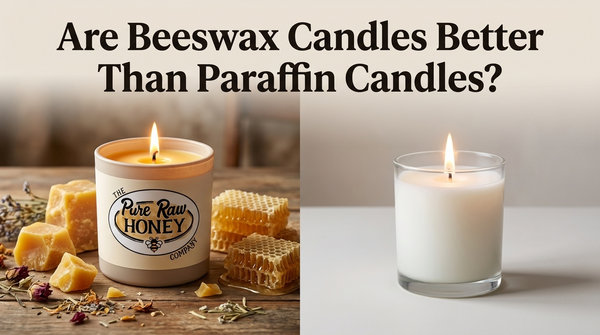
Paraffin wax is a byproduct of petroleum refining. It is created during the process of converting crude oil into fuels and lubricants, and it dominates the commercial candle market for one simple reason: it is extraordinarily cheap to produce and performs well with synthetic fragrance oils.
When paraffin burns, the chemical compounds that were dormant in the solid wax become activated by heat and released into your indoor air. Research published in multiple peer-reviewed journals has documented the following paraffin candle toxins in candle combustion emissions:
- Benzene — a known human carcinogen
- Toluene — a volatile organic compound linked to neurological effects
- Formaldehyde — classified as a probable human carcinogen
- Acetaldehyde — an irritant and potential carcinogen
- Black soot — ultrafine particulate matter similar in composition to diesel exhaust
For occasional use in a well-ventilated room, the risk from any single paraffin candle is small. But for people who burn candles regularly — multiple times per week, in living spaces and bedrooms where ventilation is limited — the cumulative exposure becomes a legitimate indoor air quality concern.
What Makes Pure Beeswax Candles Different?
Natural beeswax candles are made from a substance secreted by honeybees to construct the honeycomb cells in which honey is stored. It is one of nature's most chemically complex and biologically remarkable substances — and when it burns, the combustion products are carbon dioxide and water vapor. That is it. No petrochemicals. No synthetic compounds. No toxic byproducts.
Are Beeswax Candles Safe?
Not only are beeswax candles safe — they are actively beneficial to indoor air quality in a way that no other candle material can claim.
Negative ion emission: Pure beeswax candles emit negative ions when burned. Negative ions are naturally present in healthy outdoor environments — near moving water, in forests, after rainfall. They electrostatically bind to airborne particles including dust, pollen, mold spores, pet dander, and bacteria, causing these particles to cluster and fall out of the air rather than remaining suspended for inhalation.
This means burning a pure beeswax candle does not just avoid polluting your indoor air — it may actually improve it.
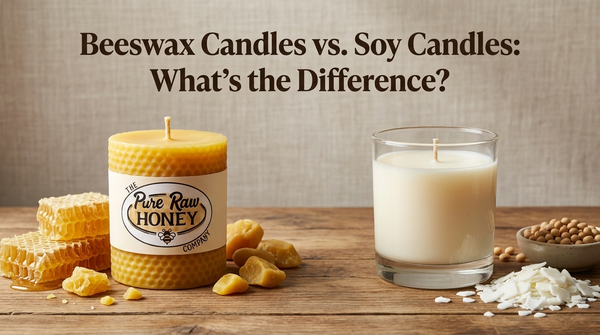
Beeswax Candles vs Paraffin vs Soy: Complete Comparison
|
Feature |
Paraffin |
Soy |
100% Pure Beeswax |
|
Raw Material |
Petroleum byproduct |
GMO soybeans (often paraffin-blended) |
Natural honeybee secretion |
|
Toxic Emissions |
Yes — VOCs, benzene, toluene |
Often — synthetic fragrance VOCs |
None |
|
Soot |
Significant black soot |
Less than paraffin |
Virtually none |
|
Negative Ions |
No |
No |
Yes — purifies air |
|
Natural Fragrance |
No (synthetic only) |
No (synthetic only) |
Yes — natural honey scent |
|
Burn Time |
Shortest |
Medium |
Longest — 2–3× paraffin |
|
Beeswax candles for air quality |
❌ Degrades |
⚠️ Neutral |
✅ Improves |
|
Safe Near Food |
❌ No |
⚠️ Marginal |
✅ Yes |
|
Eco-Friendly |
❌ No |
⚠️ Partially |
✅ Yes |
The Truth About Soy Candles
Soy candles positioned themselves as the "natural" alternative to paraffin, and many consumers accepted that framing. The reality is significantly more complicated.
Most commercially produced soy wax comes from genetically modified soybeans processed with chemical solvents including hexane. The vast majority of soy candles on the market are not 100% soy — they are blended with paraffin to improve scent throw and structural stability, though this blending is rarely disclosed on labels.
Additionally, most soy candles contain synthetic fragrance oils — complex chemical compositions that release their own volatile organic compounds when heated. The "natural" positioning of many soy candles is largely a marketing construction.
When evaluating beeswax candle vs soy candle options, pure beeswax is meaningfully superior on every metric that affects health and indoor air quality.
Beeswax Candle Benefits Beyond Safety
The safety advantage of beeswax candles is the most important factor — but the benefits extend further:
Extraordinary burn time: Pure beeswax has the highest melting point of any natural candle wax. It burns more slowly and at a higher temperature than paraffin or soy, resulting in candles that last 2–3 times longer. A beeswax candle that costs twice as much as paraffin but burns three times longer is dramatically better value.
Beautiful natural fragrance: Pure beeswax emits a subtle, warm, natural honey-and-floral scent as it burns — no synthetic fragrance required. For people with sensitivities to artificial scents, this is transformative.
The cleanest burning candles available: On every measurable metric — soot production, VOC emissions, particulate matter, toxic byproduct release — pure beeswax produces the cleanest burn of any candle material available to consumers.
A brighter, more natural flame: Beeswax burns at a color temperature close to natural sunlight — creating a flame that is brighter, steadier, and more beautiful than paraffin or soy alternatives.
🕯️ Upgrade Your Home to Pure Beeswax
Our Pure Raw Brands beeswax candles are made with 100% pure beeswax — zero paraffin blending, zero synthetic fragrances, zero compromise. They are the only candles we are comfortable recommending for a healthy home.
Shop our beeswax candle collection → purerawbrands.com/collections/candles
While you are there, explore our raw honey collection — made with the same commitment to purity and authenticity that defines everything we produce.
Frequently Asked Questions
Are beeswax candles actually non-toxic?
Yes. Pure beeswax candles produce only carbon dioxide and water vapor when burned — the same byproducts as breathing. They contain no petroleum derivatives, no synthetic additives, and no artificial fragrance compounds.
How long do beeswax candles burn compared to paraffin?
Pure beeswax candles burn 2–3 times longer than equivalent paraffin candles. A beeswax pillar candle can burn for 40–80 hours or more depending on its diameter.
Are beeswax candles safe for pets and children?
Yes — they are the safest candle option for households with pets and children. The absence of toxic combustion byproducts makes them safe to burn in bedrooms, nurseries, and living spaces.
What percentage of beeswax makes a candle "pure"?
Only candles labeled "100% pure beeswax" deliver the full health and burn benefits described in this article. Products labeled "made with beeswax" or "beeswax blend" may contain as little as a small percentage of beeswax with the remainder being paraffin or other waxes.