Honey During Ramadan and Eid: Sunnah Benefits and Daily Use Guide
Share
There is a reason honey has been part of Muslim households for over 1,400 years.
Not as a trend. Not as a wellness fad. But as a food deeply woven into the fabric of Islamic tradition, praised in the Quran, recommended by the Prophet Muhammad (PBUH), and confirmed by modern science to be one of the most nutritionally powerful natural substances on earth.
During the blessed month of Ramadan — and through the celebrations of Eid that follow it — raw honey is more than just something sweet. It is a Sunnah food, a daily wellness ritual, and a deeply intentional act of following prophetic guidance.
If you have been wondering about foods to eat during Ramadan that nourish your body, support your fast, and align with Islamic health practices — this guide is for you.
Is Honey Mentioned in the Quran?
Yes — and in the most extraordinary way.
Allah (SWT) dedicates an entire Surah to the bee. Surah An-Nahl — Chapter 16 of the Holy Quran, meaning The Bee — contains a direct reference to honey in Verse 69:
"There comes forth from their bellies a drink of varying colors wherein is healing for people. Indeed, in that is a sign for a people who give thought."
An entire chapter named after the creature that produces honey. A direct description of honey as a source of healing for humankind. This is not a passing mention — it is a declaration of profound significance, one that Muslim scholars and physicians have reflected on for centuries.
Is honey mentioned in the Quran? Undeniably, unmistakably, and with a depth of meaning that continues to inspire.
Is Honey Sunnah? What the Hadith Tells Us
Beyond the Quran, the Sunnah of the Prophet Muhammad (PBUH) places honey at the very center of Islamic medicine and daily wellness.
In Sahih al-Bukhari, one of the most authoritative collections of Hadith, the Prophet (PBUH) is reported to have said:
"Honey is a remedy for every illness."
This single statement has guided Islamic health practices for generations. It is the foundation upon which prophetic medicine — known as Tibb al-Nabawi — built its understanding of honey as one of the three greatest natural cures, alongside cupping (hijama) and the Quran itself.
Is honey Sunnah? Without question. Consuming honey with the conscious intention of following the Sunnah transforms a simple act of eating into an act of worship — a daily practice that connects body, mind, and faith in one spoonful.
The Health Benefits of Honey in Islam and Modern Science
What makes the benefits of honey in Islam so remarkable is that they are not merely spiritual or historical. Modern science has spent decades confirming what Islamic medicine understood intuitively over a thousand years ago.
Raw honey benefits that are now well-documented by research include:
- Powerful antioxidant activity — Raw honey contains phenolic compounds and flavonoids that neutralize free radicals, protect cells from oxidative damage, and reduce the risk of chronic disease
- Natural antibacterial and antimicrobial properties — Honey produces hydrogen peroxide and contains defensin-1, a protein that gives it extraordinary ability to fight harmful bacteria — a property used in medical wound care globally
- Prebiotic support for gut health — Raw honey feeds beneficial gut bacteria, supporting a healthy microbiome and improving digestive function — particularly important during Ramadan when eating patterns shift dramatically
- Immune system strengthening — The combination of antioxidants, enzymes, and antimicrobial compounds in raw honey provides comprehensive immune support, helping the body defend itself during a month of physical and spiritual intensity
- Natural energy that sustains — Unlike processed sugar that causes a sharp blood glucose spike and rapid crash, honey's unique fructose-and-glucose composition provides more balanced, sustained energy — exactly what the fasting body needs
These are not the honey benefits in Islam alone — they are confirmed, peer-reviewed, and studied in clinical settings worldwide. The Quran pointed to healing in honey fourteen centuries before laboratory science had the tools to confirm it.
Raw Honey vs Processed Honey: What the Sunnah Really Calls For
This point matters enormously and is often overlooked.
The honey consumed in the time of the Prophet (PBUH) was nothing like the clear, perfectly golden, uniformly smooth honey sitting in plastic squeeze bottles on supermarket shelves today. That honey has been heated to high temperatures, mechanically filtered to remove pollen and propolis, and in many cases blended with syrups or adulterants.
The raw honey benefits are inseparable from its natural, unprocessed state. Heat above 95°F destroys the very enzymes, antioxidants, and beneficial compounds that give honey its healing properties. Filtration removes pollen — the very substance that makes honey traceable, nutritious, and authentic.
Raw, unfiltered honey — honey as it comes directly from the hive, minimally processed and untouched by high heat — is the honey that most closely reflects what was consumed and recommended in the prophetic tradition. It is cloudier, richer in color, and far more complex in flavor than processed alternatives. And it is incomparably more powerful.
At Pure Raw Brands, every jar of honey is raw, unfiltered, and unheated — exactly as nature and tradition intended.
Sunnah Foods in Islam: Where Honey Fits
Honey does not stand alone in the prophetic dietary tradition. Among the Sunnah foods in Islam most frequently mentioned and recommended are:
- Dates — the food with which the Prophet (PBUH) broke his fast
- Black seed (Nigella sativa) — described as a cure for everything except death
- Olive oil — praised as a blessed food from a blessed tree
- Honey — described as healing for all people
What is remarkable is how powerfully these foods complement one another. Dates and honey at Iftar. Black seed and honey as a daily wellness ritual. Olive oil and honey together as a morning practice.
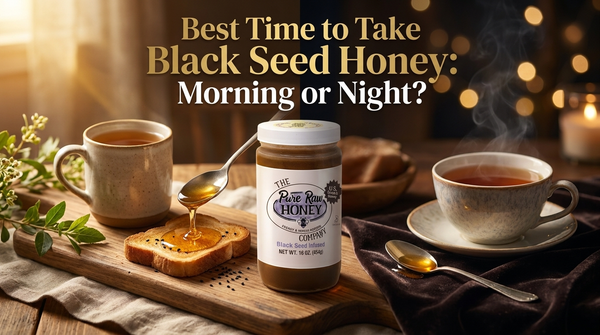
This is why Black Seed Honey from Pure Raw Brands is such a significant product — it combines two of the most powerful Sunnah foods into one jar, creating a wellness ritual that is as spiritually grounded as it is scientifically compelling.
How to Use Honey During Ramadan: A Daily Use Guide
Knowing that honey is beneficial is one thing. Knowing exactly how and when to use it during Ramadan is what transforms knowledge into practice. Here is a complete daily guide:
🌙 At Suhoor — Start the Day with Sweetness and Strength
Suhoor is the most important meal of the fasting day. What you eat at Suhoor determines your energy, focus, and physical comfort through hours of fasting ahead.
Take one to two teaspoons of raw honey at Suhoor — either on its own, stirred into warm water, drizzled over dates, or mixed with a spoonful of black seed. This provides:
Slow-releasing natural sugars that fuel the body through the fast without causing a blood sugar crash mid-morning
A gentle, protective coating for the stomach lining that supports digestive comfort through the fasting hours
Natural antimicrobial properties that help the body stay strong and resilient
Do not add honey to boiling water or hot tea. Warm water — no hotter than you can comfortably hold your hand near — is ideal. Excessive heat destroys the beneficial enzymes that make raw honey so extraordinary.
🌅 At Iftar — Break Your Fast the Prophetic Way
The Sunnah of breaking the fast is with dates and water. Honey fits beautifully alongside this tradition.
After your dates and water, and before the main Iftar meal, take a spoonful of raw honey dissolved in warm water. This gently reawakens the digestive system after a long period of rest, soothes the stomach lining in preparation for food, and delivers an immediate but balanced energy boost that prepares the body for the meal ahead.
For those who find the transition from fasting to eating uncomfortable, honey water at Iftar is one of the most effective and gentle remedies available — rooted in both tradition and nutritional science.
🕌 Before Taraweeh — Fuel Your Worship
Taraweeh prayers are a long, physically demanding, and spiritually beautiful act of worship unique to Ramadan nights. Many people find their energy flagging halfway through — particularly in the later weeks of Ramadan when fatigue accumulates.
A small spoonful of raw honey taken after Iftar and before Taraweeh provides a clean, natural energy top-up. It fuels the body for extended standing and movement without the heaviness of a large meal and without the artificial stimulation of caffeine.
🌟 Before Sleep — Support Your Recovery Overnight
The overnight hours of Ramadan are precious. Between Taraweeh, late-night meals, early Suhoor, and Fajr prayers, sleep is often limited and fragmented.
A teaspoon of raw honey before sleep fuels the liver's glycogen stores, which the body draws on during overnight fasting to maintain stable blood sugar levels and support restorative sleep. Many people who add honey to their pre-sleep routine report waking for Suhoor feeling more rested and more energized.
Honey at Eid: Sweetness as a Celebration
When Ramadan ends and Eid al-Fitr arrives, honey takes on a celebratory dimension that is equally beautiful.
Across Muslim cultures worldwide — from the Middle East to South Asia to North Africa to the United States — honey plays a central role in Eid food traditions. Honey-drenched pastries, honey-sweetened teas, honey drizzled over Eid morning breakfast, and jars of premium raw honey given as gifts to family and friends.
Gifting honey at Eid is one of the most Sunnah-aligned gestures you can make. It says: I want to give you something that nourishes you. Something that the Prophet (PBUH) recommended. Something that will benefit you long after Eid day is over.
Explore the full range of raw honey varieties at Pure Raw Brands — including our signature Black Seed Honey, Wildflower Honey, Orange Blossom Honey, and more — and find the variety that will become your Ramadan and Eid companion this year and every year.
A Final Reflection
The health benefits of honey are extraordinary. The benefits of honey in Islam are profound. But perhaps the most beautiful thing about incorporating raw honey into your Ramadan and Eid routine is the integration it creates — between body and spirit, between ancient wisdom and modern understanding, between the act of nourishing yourself and the act of following the guidance of the Prophet (PBUH).
Every spoonful, taken with intention, is both medicine and worship.
May your Ramadan be filled with barakah, your fasts be accepted, and your Eid be as sweet as the honey you share with the ones you love.