Raw Honey vs Organic Honey: Understanding the Difference Before Buying
Share
When shopping for honey, words such as "raw," "organic," "pure," and "unfiltered" can make a simple purchase surprisingly confusing. Two of the most commonly compared terms are raw and organic. They may appear together on some products, but they do not mean the same thing.
The basic raw honey vs organic honey distinction is relatively simple: raw generally describes how honey is handled after harvesting, while organic relates to how the product is produced and certified according to applicable organic standards.
That means honey may be raw without being certified organic, and an organic honey product is not necessarily raw.
Understanding this distinction can help you make a more informed choice rather than assuming one word automatically means higher quality. This guide explores organic honey vs raw honey, labeling, processing, certification, flavor, storage, and what consumers should consider before buying.
What Is Raw Honey?
Raw honey generally refers to honey that undergoes relatively minimal processing after it is harvested from the hive.
Honey bees collect nectar from flowers and transform it through natural processes within the colony before storing it in honeycomb cells. Once mature honey is harvested, it may be strained to remove larger pieces of wax and other material before packaging.
The exact handling practices can vary between producers. This is why consumers should read product descriptions instead of assuming every honey labeled raw has been treated in exactly the same way.
Raw honey can naturally vary in color, texture, aroma, and flavor.
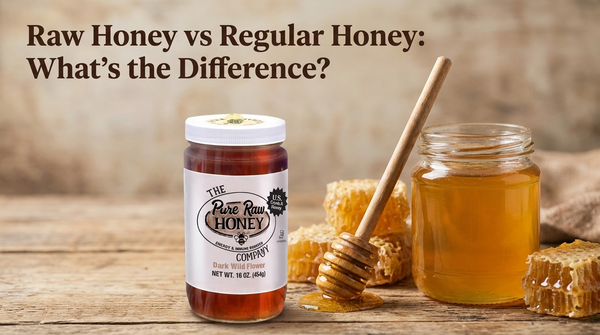
Consumers looking for an everyday minimally processed option can explore Raw Unfiltered Honey 16oz from Pure Raw Brands.
What Is Organic Honey?
Organic honey refers to honey produced according to applicable organic production and certification requirements.
Unlike "raw," organic does not primarily describe whether the honey was heated or filtered after harvesting. It concerns the standards governing how the product is produced and handled.
Organic certification requirements can vary by country and certifying authority. They may address matters such as hive management, substances used in beekeeping, environmental conditions, processing, recordkeeping, and other production practices.
This makes certification important.
Consumers should not assume that honey is certified organic merely because a label uses words such as "natural," "pure," or "farm fresh."
If organic certification matters to you, look for appropriate certification information on the specific product rather than relying on general marketing language.
What Is the Difference Between Organic and Raw Honey?
The difference between organic and raw honey is primarily about what each term describes.
Raw relates mainly to processing.
Organic relates mainly to production standards and certification.
A useful way to remember the distinction is:
Raw = how the honey is handled after harvesting.
Organic = how the honey is produced according to defined organic requirements.
Because these concepts address different parts of production, a honey product can potentially fit both descriptions when it meets the applicable requirements.
However, one does not automatically guarantee the other.
A raw product should not automatically be described as organic unless it satisfies applicable organic standards, and organic honey should not automatically be assumed to be raw unless the product information confirms it.
Is Raw Honey Organic?
The answer to is raw honey organic is: not necessarily.
A producer may harvest honey and minimally process it without pursuing or meeting organic certification requirements.
In that case, the honey may appropriately be described as raw based on its handling, but that alone does not make it certified organic.
Similarly, consumers should avoid assuming that local, natural, wildflower, unfiltered, or pure honey automatically qualifies as organic.
These words describe different characteristics.
If certification is an important purchasing factor, check the product label and supporting information for specific organic certification rather than making assumptions based on appearance or processing.
Accurate terminology helps consumers compare products more fairly.
How Does Processing Differ Between Raw and Organic Honey?
Raw honey is generally associated with minimal processing, so processing is central to its identity.
Organic honey, however, can still undergo permitted processing while maintaining organic status, provided applicable standards are followed.
This is one of the reasons organic honey vs raw honey should not be treated as a comparison between "processed" and "unprocessed."
Honey processing exists on a spectrum.
Straining can remove larger pieces of wax. Filtration can produce a clearer product. Heating can make honey easier to handle and package and can delay visible crystallization under some conditions.
When processing characteristics matter to you, read the individual product description rather than relying entirely on the organic label.
Which Is Better Raw Honey or Organic Honey?
Consumers frequently ask, which is better raw honey or organic honey?
There isn't one answer that fits everyone because the two labels address different priorities.
Raw honey may appeal to someone who prioritizes minimal processing and wants honey that remains relatively close to its harvested condition.
Certified organic honey may appeal to someone who specifically prioritizes production according to recognized organic standards.
Some consumers may look for a product that satisfies both preferences.
Neither term alone establishes everything about flavor, freshness, authenticity, or overall product quality.
A better buying decision considers processing, ingredients, seller transparency, certification when relevant, floral source, package size, and intended use.
What Does Floral Source Mean When Choosing Raw Honey?
Floral source can have a noticeable effect on honey's sensory characteristics.
Bees collect nectar from flowers available around their hives, and different nectar sources can contribute different colors, aromas, and flavors.
For example, Blueberry Blossom Honey Unfiltered 16oz provides a different floral experience from a darker wildflower variety.
Consumers interested in another blossom profile can consider Orange Blossom Honey 16oz.
Neither floral variety is automatically better because of its color or name.
Think of floral source partly as you would think about different varieties of tea or coffee: individual preferences matter.
How Do Raw and Organic Honey Look Different?
You generally cannot identify raw or organic honey by appearance alone.
Raw honey may sometimes look cloudier or contain tiny natural particles because it has undergone less filtration. However, appearance varies considerably.
Organic certification cannot be seen in the honey itself.
An organic honey might be light, dark, clear, cloudy, liquid, or crystallized depending on floral source, processing, storage, and other factors.
This means color is not an organic test.
Thickness is not an organic test either.
Consumers should rely on labeling, certification information, and product transparency rather than trying to visually determine whether a jar qualifies as organic.
How Does Crystallization Affect Raw and Organic Honey?
Crystallization is a natural process that occurs in many genuine honeys.
Honey contains glucose and fructose. Under suitable conditions, glucose can begin forming crystals, changing the texture from smooth and liquid to thicker or grainier.
The rate depends on factors such as floral source, sugar composition, storage temperature, moisture, and processing.
Raw honey may sometimes crystallize relatively quickly because small naturally occurring particles can provide sites for crystals to form.
However, crystallization does not tell you whether honey is organic.
Likewise, crystallized honey is not automatically spoiled or poor quality.
Consumers who prefer deeper floral varieties can explore Dark Wildflower Honey 16oz, while remembering that texture may naturally change during storage.
What Are Organic Raw Honey Benefits?
Searches for organic raw honey benefits often produce exaggerated health claims.
A honey that is both certified organic and raw may appeal to consumers who want two particular characteristics: production according to organic standards and relatively minimal post-harvest processing.
Raw honey also contains naturally occurring compounds associated with nectar and honey production, although exact composition varies.
However, consumers should maintain realistic nutritional expectations.
Honey is primarily composed of sugars. Organic certification does not make those sugars disappear, and raw honey is not sugar-free simply because it is minimally processed.
Neither raw nor organic honey should be presented as a cure for disease.
The strongest reasons for choosing these products often involve production preferences, processing preferences, flavor, and personal food-buying priorities rather than extraordinary medical promises.
How Can You Identify the Best Organic Raw Honey?
If you're searching for the best organic raw honey, avoid choosing solely according to words printed prominently on the front label.
First, verify whether the product actually makes an organic certification claim and whether appropriate certification information is provided.
Then evaluate the same practical qualities you would consider when buying other honey:
- Ingredient information
- Processing description
- Floral source
- Seller transparency
- Packaging
- Package size
- Intended use
- Flavor preference
If a product claims to be both raw and certified organic, look for information supporting both characteristics.
"Natural" does not automatically mean organic.
"Pure" does not automatically mean organic.
"Raw" does not automatically mean organic.
Clear labeling is more valuable than assumptions.
Why Does Seller Transparency Matter?
Honey can be difficult to evaluate based only on a photograph of the jar, especially when shopping online.
A transparent seller should make it reasonably easy to understand what you're ordering.
Look for clearly identified products, sizes, descriptions, and accessible company information.
You should also be cautious when a seller relies heavily on dramatic wellness promises but provides little meaningful information about the actual honey.
Transparency builds confidence because consumers can make decisions using specific product details rather than marketing language alone.
How Can You Choose Honey for Different Uses?
Your intended use should influence your purchase.
For tea, toast, oatmeal, yogurt, dressings, and general kitchen use, a versatile honey may be the most practical choice.
Frequent honey users may prefer a larger container such as Raw Unfiltered Honey 44oz.
For savory meals, a specialty product can provide a different flavor experience. Hot Honey 16oz, for example, combines sweetness with heat for dishes such as pizza, roasted vegetables, sandwiches, and chicken.
The "best" honey isn't determined only by whether the label says raw or organic. Flavor and intended use matter too.
How Should Raw or Organic Honey Be Stored?
Honey should generally be stored in a tightly closed container in a dry place away from excessive heat and direct sunlight.
Use clean, dry utensils to prevent unnecessary moisture from entering the container.
Refrigeration is generally unnecessary and can encourage crystallization.
If honey crystallizes during storage, don't automatically assume it has gone bad. Crystallization can occur naturally.
People who enjoy honey in a less extracted form can also explore Freshly Harvested Raw Honeycomb, which keeps honey within its natural wax cells.
Regardless of the form you choose, follow any storage directions provided with the specific product.
When Should You Be Cautious About Honey Claims?
Consumers should be skeptical of claims that raw or organic honey can prevent, treat, or cure serious medical conditions.
Organic certification describes production standards. It does not transform honey into medicine.
Likewise, raw honey should be understood as a food rather than a substitute for professional medical treatment.
People who need to monitor sugar or carbohydrate intake should consider honey within their overall diet and seek individualized professional advice when appropriate.
Most importantly, honey should never be given to infants younger than 12 months because of the risk of infant botulism. This applies regardless of whether the honey is raw, regular, organic, or processed.
Where Can You Buy Raw Honey Online?
Consumers looking for different raw and specialty honey options can browse Pure Raw Brands.
Compare individual product descriptions rather than relying on one label term. Consider floral source, ingredients, size, processing, intended use, and any certification claims relevant to your purchasing priorities.
Before completing your order, you can also review the free shipping information.
Businesses interested in larger purchasing quantities can find additional details on the wholesale page.
Choose the variety that fits your taste and intended use, review its individual product information, add your preferred honey to your cart, and complete your order online.
What Are Common Questions About Raw Honey vs Organic Honey?
1. What is the main difference between raw honey and organic honey?
Raw generally refers to minimal post-harvest processing, while organic refers to production according to applicable organic standards and certification requirements.
2. Is raw honey automatically organic?
No. Honey can be raw without being certified organic because raw processing and organic certification describe different characteristics.
3. Can organic honey also be raw?
Potentially, yes. A product can satisfy both descriptions if it meets applicable organic requirements and is also handled according to the producer's raw-honey practices.
4. Which is better, raw honey or organic honey?
Neither is universally better. Choose according to whether you prioritize minimal processing, certified organic production, flavor, floral source, transparency, or a combination of these factors.
5. Is natural honey the same as organic honey?
Not necessarily. "Natural" does not automatically indicate that a product has met recognized organic certification requirements.
6. Does organic honey taste different?
It may, but organic certification alone does not determine flavor. Floral source, geography, season, processing, and storage can all influence taste.
7. Does organic honey crystallize?
Yes. Organic honey can crystallize naturally. Crystallization depends on composition, floral source, temperature, storage, and other factors rather than organic status alone.
8. Is raw honey healthier because it is less processed?
Raw honey may retain characteristics associated with minimal processing, but it remains a source of sugars and should be consumed with appropriate portion awareness.
9. How can I identify certified organic honey?
Review the product packaging and description for recognized organic certification information rather than assuming terms such as raw, pure, or natural mean certified organic.
10. Can infants eat organic or raw honey?
No. Infants younger than 12 months should not consume honey of any type because of the risk of infant botulism.
Medical Disclaimer
This article is for general educational purposes and is not medical advice. Never give honey to infants under 12 months; consult a qualified healthcare professional for individual dietary or health concerns.